
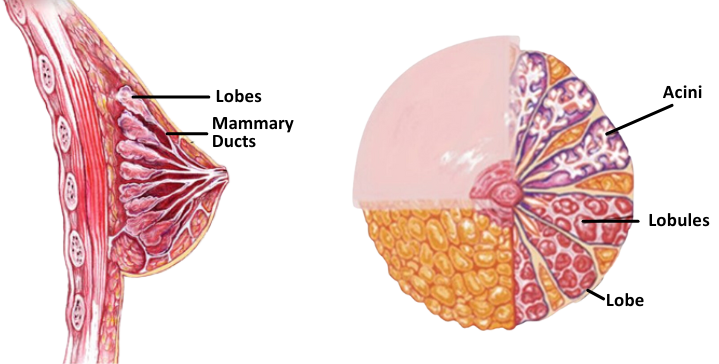
Each breast contains 15-20 lobes that radiate out from the nipple liked a spoked wheel. The lobes do not connect to each other, and milk is produced independently in each system. Cancer developing in this area is referred to as Lobular Carcinoma.
Mammary ducts are those passageways that converge and form a branched system connecting to the lobes and carry milk to the nipple. They are also referred to as galactophores, lactiferous ducts, or milk ducts. Cancer which develops in the tubes is called Ductal Carcinoma; this accounts for 80% of breast cancers.
Each lobe houses smaller glands called lobules.
Lobules are glands that are the site of milk production.
Acini (alveoli)- Acini, also known as alveoli are tiny structures housed within the lobules, which develop during pregnancy. The function of the acini is milk development.
Show Audio Transcript
Breasts are mainly made up of two types of tissue- fatty tissue and glandular tissue, which is a specialized tissue that produces milk. Glandular tissue is the site most likely for breast cancer to develop. Click each label to learn more about the structures found within the glandular tissue.